
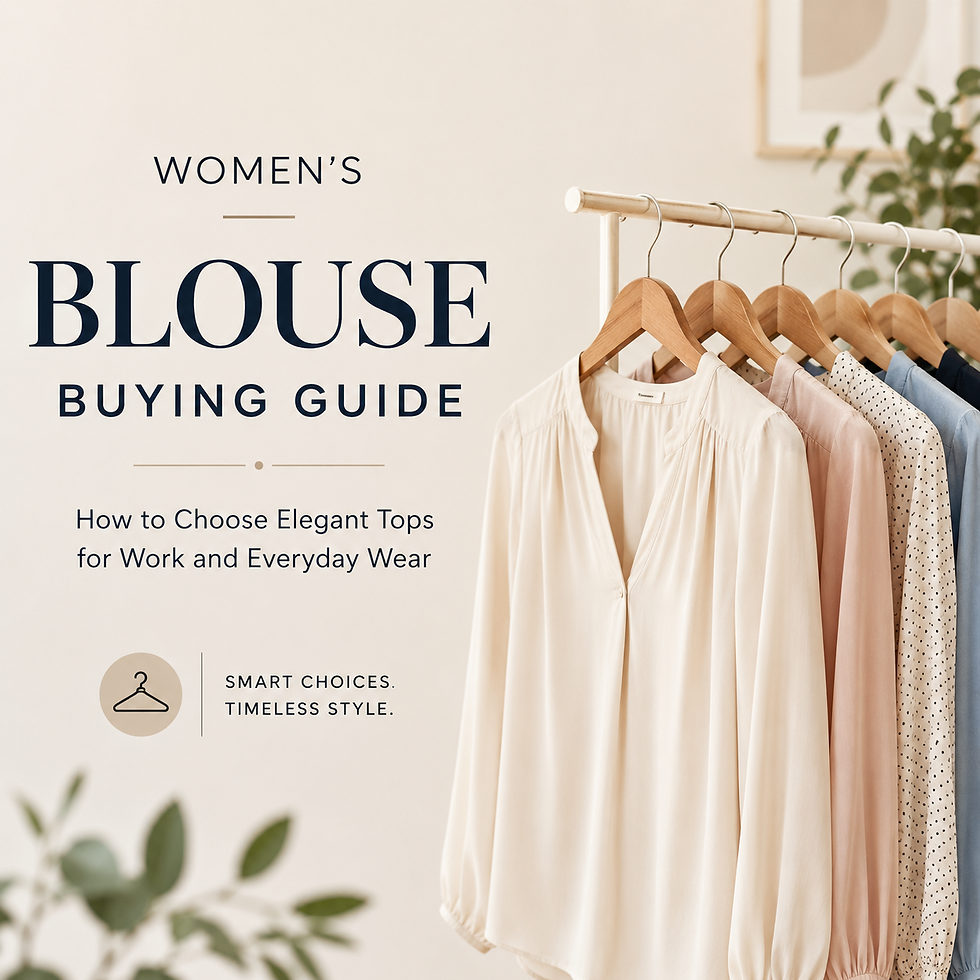
Women's Blouse Buying Guide: How to Choose Elegant Tops for Work and Everyday Wear

Finding a blouse that survives a full day at the office and still feels like "you" on a Saturday isn't as simple as it sounds. Plenty of tops look sharp on a hanger, then wrinkle by 10am, restrict your movement in meetings, or feel wrong the moment you pair them with jeans. A genuinely useful women's blouse buying guide looks past trends and gets into the details that actually matter: fabric behaviour, fit, neckline, sleeve length and how easily a piece moves between settings.
This guide walks through those decisions step by step, so you can build a blouse collection that works harder without trying harder.
What Makes a Blouse Suitable for Both Work and Everyday Wear?
A blouse that performs well in more than one setting usually balances four things: polish, comfort, practicality and styling flexibility. Polish comes from fabric quality, clean lines and thoughtful detailing rather than anything stiff or fussy. Comfort matters just as much—if you're adjusting a neckline or tugging at sleeves through a client meeting, the blouse isn't doing its job.
Practicality covers the unglamorous but important stuff: does it crease easily, does it need special washing, does it layer under a blazer without bulk? Styling flexibility is what lets one blouse earn its place in rotation, moving from a desk to dinner with a change of shoes and accessories rather than sitting in the wardrobe as a single-outfit item.
Start with Where You Plan to Wear It
Before looking at cut or colour, it helps to think honestly about where the blouse will actually be worn. Workplace dress codes vary enormously across Australia, and what reads as professional in one office might feel underdressed—or overdressed—in another.
A few common settings to consider:
Formal offices often call for tailored, structured pieces in neutral tones with minimal embellishment.
Business-casual workplaces allow more room for softer fabrics, gentle prints and relaxed silhouettes, as outlined in this overview of business casual dress conventions.
Creative workplaces tend to welcome texture, colour and personality-driven pieces.
Casual days, lunches and shopping trips give you space to experiment with prints, cropped lengths or statement details.
Weekend occasions are where a blouse can be dressed down entirely, paired with denim or worn open over a simple top.
If you're shopping with more than one setting in mind, it's worth browsing the full range of women's blouses to compare styles side by side before deciding.
Choose a Fabric That Fits Your Day
Fabric affects how a blouse feels far more than most people expect. A breathable, lightweight weave moves with you and won't cling by the afternoon, which matters if you're commuting, sitting through back-to-back meetings, or spending hours on your feet. Fabrics with a bit of drape tend to skim the body rather than sit rigidly, giving a softer, more relaxed line.
Texture also plays a role. Some fabrics add visual interest through subtle weave or print, while others rely on a smooth, structured finish for a crisper look. Neither is inherently better—it depends on the occasion and how much structure you want the blouse to hold. Care requirements are worth checking too, since a blouse that needs specific washing or ironing may not suit a busy week, even if the fabric feels lovely in-store.
Find a Fit That Feels Comfortable and Looks Polished
Fit is personal, and there's no single silhouette that works for everyone. What matters most is how the blouse moves with your body and whether the proportions feel right to you.
Relaxed fits allow more room through the body and sleeves, which suits those who prefer ease of movement or a more casual line.
Standard fits sit close without being tight, offering a balanced shape that works well under blazers.
Fitted styles follow the body more closely for a streamlined look, without needing to feel restrictive.
Longline blouses extend past the hip, which can be useful for layering over trousers or wearing with leggings.
Cropped styles sit higher at the waist and work best with higher-rise bottoms.
Rather than chasing a "flattering" formula, focus on how the fabric sits when you move—can you raise your arms, sit down and reach for something without the blouse pulling or riding up? That's a better test than how it looks standing still.
Consider Necklines, Collars and Front Details
The neckline sets the tone of a blouse more than almost any other detail. A round neckline gives a simple, understated look that suits most workplace settings, while a collar adds a slightly more traditional, structured feel—useful if you want a blouse to read as a shirt rather than a soft top.
Ruffled details bring a feminine, softer edge and work particularly well for blouses meant to feel a touch more occasion-ready without becoming overly formal. The Rose Veil Blouse, for instance, uses a ruffled neckline alongside a button-front design, which keeps the overall look refined while still being practical to put on and take off. Button-front designs generally offer more versatility than pull-over styles too, since they're easier to layer and adjust throughout the day. V-necklines, meanwhile, tend to suit statement or occasion pieces where you want a slightly more elevated finish.
Choose the Right Sleeve Length
Sleeve length affects both comfort and how formal a blouse feels. Short sleeves work well for warmer months, casual Fridays or workplaces with a relaxed dress code, and they're easy to layer under a light cardigan if the office air conditioning runs cold. The Aligned Short Sleeve Blouse is a good example of this—a lightweight, breathable woven top with a classic collar and button placket that can move between a desk and a weekend lunch without feeling like two different outfits.
Long sleeves generally read as slightly more polished and suit cooler weather or more traditional offices. Gathered cuffs and lightly puffed sleeve details, like those found on the Grace Long Sleeve Blouse, add a bit of texture and softness without looking overly casual—useful if you want a blouse that feels considered rather than plain. Sleeve length is also worth checking against your workplace's air conditioning and your own comfort in changing temperatures throughout the day.
Select Colours and Prints You Will Actually Wear
There's no strict rule about which colours are "professional" and which aren't—dress codes and personal style both vary too much for that. That said, a few practical points are worth considering.
Neutral and soft shades tend to be the easiest to mix with existing pieces, which makes them a sensible starting point if you're building a small, versatile blouse collection. Prints and statement designs add personality and work well once you already have a few neutral pieces to pair them with. A patterned top like the Paisley Aura Satin Top suits social occasions or elevated casual styling particularly well, though its cropped length means it's worth checking your workplace dress code before wearing it to the office.
Ultimately, the most useful colours and prints are the ones you'll reach for often—not the ones a style rule says you should own.
How to Style Women's Blouses for Work
A handful of reliable outfit formulas can take the guesswork out of getting dressed on busy mornings:
Blouse with tailored trousers – a straightforward, dependable combination for most office settings.
Long-sleeve blouse with a blazer – adds structure and works well for meetings or more formal days.
Short-sleeve blouse with a midi skirt – a softer, warm-weather alternative that still feels put-together.
Longline shirt with straight-leg trousers – the added length of a piece like the Grace Longline Shirt creates a clean, elongated line, particularly when the button detailing and polo collar are left open over a simple layer beneath.
Subtle statement blouse with simple separates – letting one printed or textured piece stand out while keeping the rest of the outfit understated.
None of these require a full wardrobe overhaul—most rely on pieces you likely already own, paired thoughtfully with one well-chosen blouse.
How to Restyle the Same Blouse for Everyday Wear
The same blouse can look entirely different depending on what you pair it with. Swapping heels for sneakers or flats instantly shifts a blouse from office-ready to weekend-appropriate. Denim is one of the easiest ways to dress a blouse down—tucked into straight-leg jeans, a workwear blouse can move seamlessly into a casual lunch or errands.
Layering also changes the mood of a piece. A cardigan or light jacket over a blouse softens the look, while leaving it unbuttoned over a simple singlet creates a more relaxed, layered silhouette. Accessories matter too: a structured bag and minimal jewellery keep things office-appropriate, while a canvas tote and looser hair can shift the same top into weekend territory. Small adjustments like these are usually enough—there's rarely a need to buy separate "work" and "weekend" wardrobes when a few key pieces can do both.
Shiva Luxe Blouses for Different Style Needs
Product | Key Design Details | Best Suited For | Simple Styling Idea |
Lightweight textured fabric, ruffled neckline, button-front, long sleeves with gathered cuffs | Polished everyday outfits or softer workwear styling | Pair with tailored trousers and low heels for a refined office look | |
Lightweight breathable woven fabric, classic collar, button placket, short sleeves, relaxed fit | Transitioning between work and casual weekend styling | Tuck into jeans with flats for weekend errands, or trousers for the office | |
Round neckline, lightly puffed sleeves with gathered cuffs, lightweight draping fabric, fitted-not-tight silhouette | Elegant everyday or office outfits | Layer under a blazer for meetings, or wear alone with a midi skirt | |
Polo-style collar, long sleeves, crochet fabric, button detailing, standard fit | Adding length and texture to casual or dressed-up outfits | Wear open over a simple top with straight-leg trousers | |
Cropped length, V-neck, sleeveless, satin fabric, paisley print, boho styling | Social occasions or elevated casual styling (check dress code for office wear) | Pair with high-rise trousers or a skirt for evening plans |
Practical Questions to Ask Before Buying a Blouse
Before adding a blouse to your cart, it can help to run through a short checklist:
Where will I actually wear it—office, weekend, or both?
Can I move comfortably in it, including sitting, reaching and layering?
Does it work with clothing I already own, or will it need new pieces to style?
Does the fabric suit the climate and season I'll wear it in most?
How much care does it require—can I realistically keep up with washing or ironing?
Can I style it in more than one way, for more than one setting?
Does the neckline and sleeve length suit the settings I have in mind?
If a blouse ticks most of these boxes, it's more likely to earn regular wear rather than sit unused.
Common Blouse-Buying Mistakes
A few habits tend to lead to blouses that don't get much wear. Buying with only one outfit in mind is a common one—a blouse chosen to match a single pair of trousers may end up rarely worn once that outfit falls out of rotation. Overlooking care requirements is another; a beautiful blouse that needs hand-washing or dry cleaning may quietly become the piece you avoid reaching for.
Ignoring proportions is worth watching too—a longline shirt paired with an already loose bottom can look shapeless, while balancing a relaxed top with something more fitted below usually reads better. Choosing appearance over comfort is a mistake many people make once and don't repeat, since a blouse that pulls or restricts movement rarely gets a second wear. Finally, skipping a check of the workplace dress code before buying a statement or cropped piece can mean a lovely top ends up reserved for weekends only, even if that wasn't the original plan.
Final Thoughts
Choosing a blouse that works for both office days and everyday life comes down to a handful of practical decisions—fabric, fit, neckline, sleeve length and how easily it pairs with what you already own. None of these require compromising on style; they simply help you buy pieces that get worn often rather than pieces that look good once and then sit in the wardrobe.
If you're ready to look through options with these details in mind, the Shiva Luxe blouse and top collection is a reasonable place to start, with pieces designed around comfort, movement and everyday versatility rather than one-outfit styling.
Frequently Asked Questions
What type of blouse is best for work?
It depends on your workplace, but a well-fitted blouse in a breathable fabric with a simple neckline tends to suit most office settings. Long sleeves and structured collars generally read as slightly more formal, while softer, relaxed styles work well in business-casual environments. Checking your specific dress code is always worth doing first.
Can a blouse be worn casually?
Yes. Most blouses can be dressed down with denim, flats or sneakers, and simpler accessories. Unbuttoning a blouse over a singlet or leaving it untucked also shifts the look toward casual. The same piece can often move between work and weekend with only small styling changes.
Are short-sleeve blouses suitable for the office?
Often, yes—particularly in business-casual or creative workplaces, or during warmer months. A short-sleeve blouse with a collar and button placket can look just as polished as a long-sleeve style. It's worth checking your workplace's specific expectations if you're unsure.
How should a women's blouse fit?
A well-fitting blouse allows comfortable movement through the arms and shoulders without pulling or gaping at the buttons. Fit preferences vary—some prefer a relaxed silhouette, others a more fitted line—but the fabric should sit smoothly rather than straining across the body when you move.
What colours are easiest to style for work and everyday wear? Neutral and soft shades are generally the easiest to mix with existing wardrobe pieces, making them a practical starting point. Prints and statement colours add variety once you have a few versatile basics in place. There's no fixed rule—personal style and dress code both play a role.

Comments